A client record that tells you everything
Contacts, opportunities, past and live assignments, exchanges, documents and invoices on a single page.
- Accounts, contacts and leads
- Full history of exchanges
- Documents and contracts attached
An agency sells a service before it delivers it. On one side, prospecting, meetings and proposals. On the other, assignments, candidates and interviews. When those two worlds sit in two different pieces of software, nobody really knows what a client earns you, or where a deal stands.
In Nicoka CABS, the CRM is not a module bolted on the side: it is the same database. A won opportunity opens an assignment, the assignment produces a placement, the placement becomes an invoice, and everything stays attached to the client account.
Four stages, one database, no re-entry between sales and recruitment.
Leads, accounts and contacts sourced, then qualified. Every exchange, call or message stays attached to the record.
A visual pipeline stage by stage, with amount, deadline and next action. You see what is about to be signed.
The won deal opens the recruitment assignment, with the same client and the same contacts.
Quotes, invoices, payment schedules and revenue tracking by client and by consultant.
Your opportunities move stage by stage, with their amount, their deadline and the next action. Stop steering on gut feel: know, deal by deal, what is missing to close.
Example pipeline. Fictional data.
Commercial follow-up is won on consistency. Multichannel sequences chain LinkedIn messages, emails, SMS and call tasks, with branches based on the reply you get.
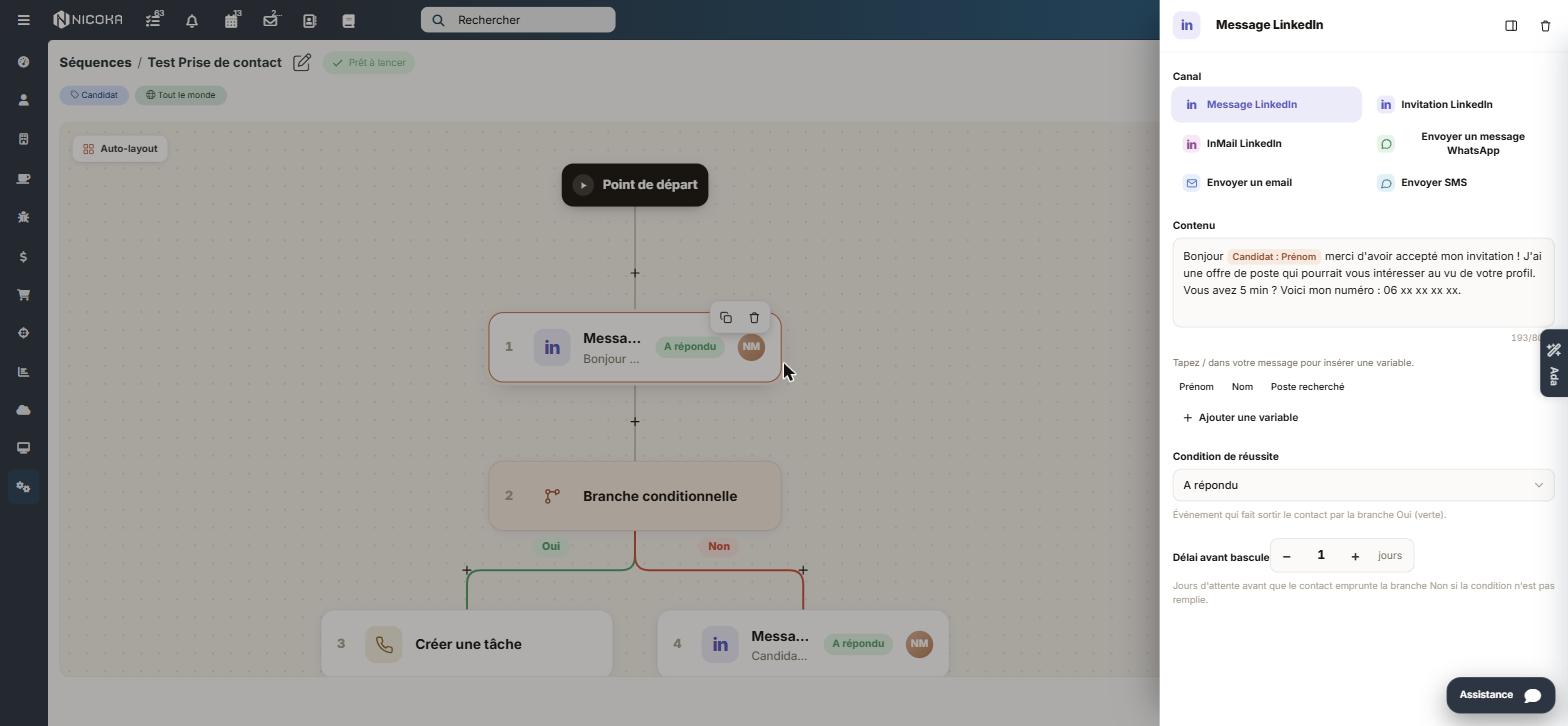
Sequence builder in Nicoka CABS. Fictional data.
Six everyday situations that change when both trades share one database.
Contacts, opportunities, past and live assignments, exchanges, documents and invoices on a single page.
The weighted pipeline gives expected revenue by period and by consultant, with no spreadsheet running alongside.
Multichannel sequences, message templates and dated tasks: follow-up no longer depends on anyone's memory.
A signed opportunity opens the recruitment assignment, with the right client, the right contacts and the agreed terms.
Quotes, invoices, payment schedules and collection tracking follow the placement, without moving to another piece of software.
Revenue by client, by consultant and by assignment, with dashboards and reports you can compare from one period to the next.
The CRM is not an add-on: it is part of Nicoka CABS, alongside the ATS, sales and AI.
Recruitment agencies, IT services firms and staffing agencies run their commercial activity in Nicoka CABS.
Consultants, researchers and directors work on the same client accounts.
What we get asked about the Nicoka CABS CRM
Commercially, a recruitment agency is not a business like any other. It sells a service whose raw material, the candidate, is managed in another piece of software. Hence the most common setup on the market: an ATS for applications, a generic CRM for clients, a spreadsheet for revenue, and exports to try to tie the three together.
That separation costs three things. First, time: the same contact is created twice, in two tools, with two histories. Then clarity: there is no way to know what a client really earns you, because assignments live on one side and invoices on the other. And finally quality of follow-up: the consultant presenting the candidates cannot see the commercial promise their colleague made.
A generic CRM knows how to run a deal pipeline. It does not know what a recruitment assignment, a shortlist, a placement or success fees are. So the reconciliation is done by hand, or not at all.
In Nicoka CABS, the CRM shares the database of theATS. In practice, a won opportunity opens a recruitment assignment with the same client and the same contacts. The candidate presented to the client is visible from the account record. The placement turns into an invoice, attached to the original deal.
Lead and contact management and client accounts are therefore not isolated directories: they are the very records used during recruitment.
Prospecting in an agency looks a lot like its sourcing: identify, approach, follow up, qualify. So the same tools serve both sides. The Nicoka plugin creates a contact from a LinkedIn profile. The multichannel sequences chain LinkedIn messages, emails, SMS and call tasks, with branches based on the reply you get. The inbox keeps every exchange in the contact record, whatever the channel.
An agency director needs three simple answers: what is about to be signed, what is in production, what has been invoiced. When those three sit in the same tool, the reports and the dashboards give them straight away, by client, by consultant and by period, with a comparison against the previous year.
That is also what makes a precise commercial conversation with a client possible: how many assignments entrusted, how many successful placements, what average time to hire, what volume of fees.
Go further: sales and invoicing, mobile app, pricing.