Candidate sourcing: search less, find better
Sourcing has become the core of the recruiter's trade. On most skilled roles, speculative applications are no longer enough: you have to go and find profiles who are not looking, approach them, win them over. The problem is not knowing where to look, everyone knows LinkedIn. The problem is what happens between the spotted profile and the engaged candidate.
What scattered sourcing costs
The scenario is a familiar one: a consultant spots a profile on LinkedIn, copies the name into a spreadsheet, sends a message, forgets to note the reply. Three months later a colleague approaches the same candidate, unaware they have already been contacted, or what had blocked it. Meanwhile the agency's CV database may well hold that profile already, sourced on an earlier assignment.
That scattering costs three things: search time done twice over, credibility with candidates approached twice, and the value of the talent pool you have built up, which stays unusable for want of qualification.
Source where the recruitment lives
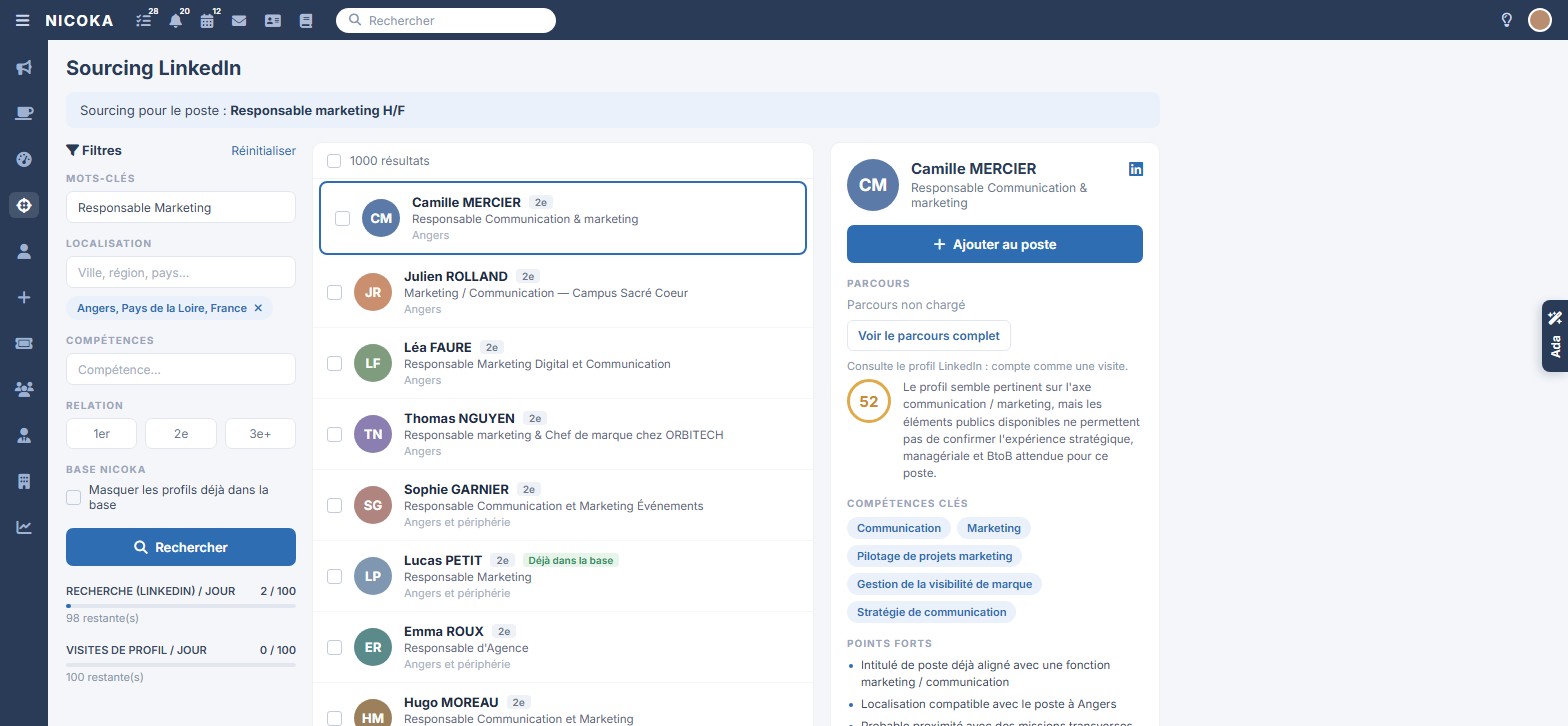
The answer comes down to one principle: sourcing has to happen in the tool that already carries the roles, the applications and the exchanges. In Nicoka CABS, the sourcing screen is attached to the open role. You filter by keyword, location, skills and connection degree, you see immediately which profiles are already in your database, and you add a candidate to the assignment in one click.
The Nicoka plugin rounds this out across ten CV databases: LinkedIn, LinkedIn Recruiter and Sales Navigator, HelloWork, CVaden, Apec, France Travail, Turnover-IT, Indeed, MeteoJob, Agefiph and Pappers. On a profile page it creates the candidate or the contact in Nicoka CABS, or shows their record if they are already known. For teams working in LinkedIn Recruiter, a Nicoka role links to a Recruiter project: candidates added to the project are imported into the role automatically, with nothing to redo by hand.
Your internal talent pool, the first place to look
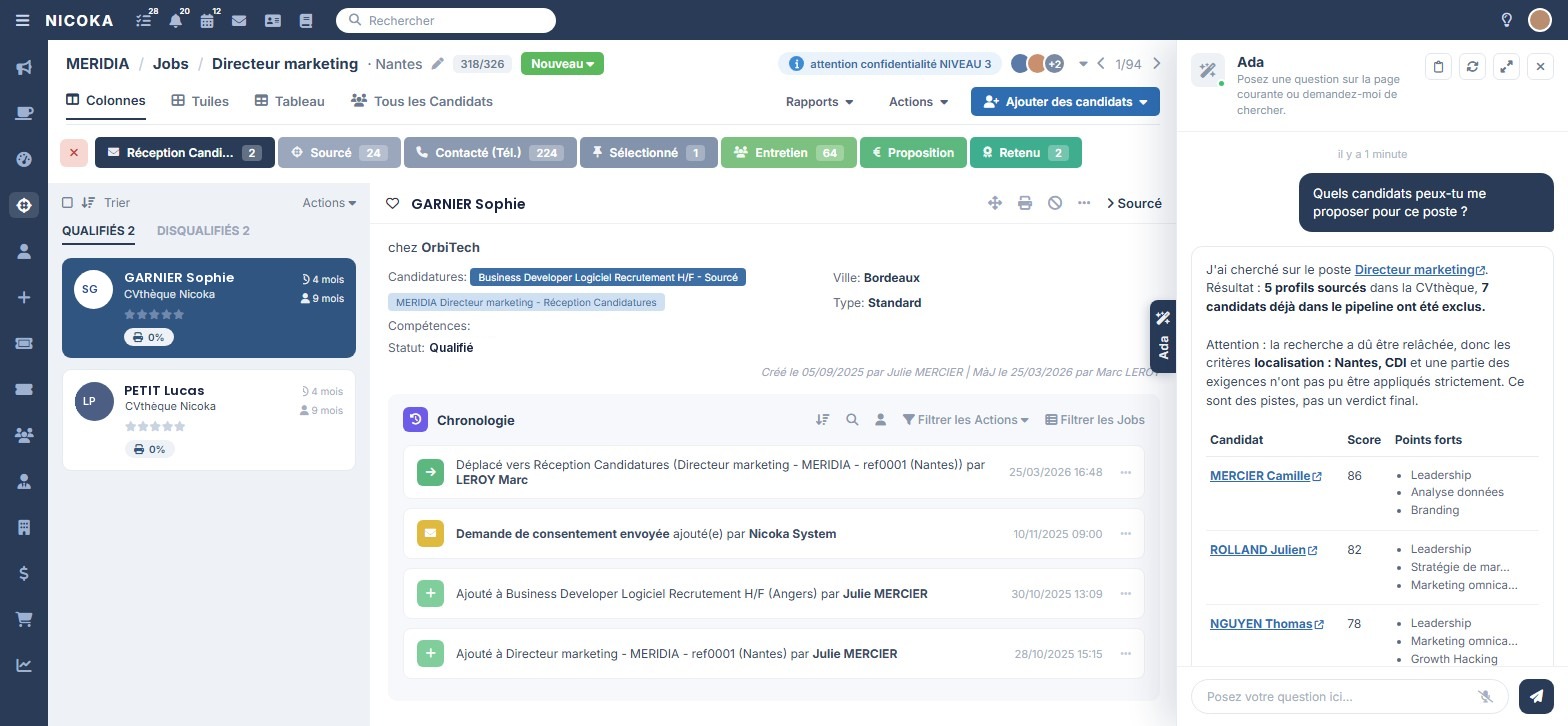
Before opening LinkedIn, the question to ask is a simple one: do I already have this profile? On a pool of several thousand candidates the answer is often yes, but you still have to find them. Candidate search combines an advanced engine (skills, experience, location, tags, availability) with a natural-language search: you describe the role, and Ada suggests the matching profiles, with a score and each one's strengths.
Ada also says what it set aside and which criteria it had to relax to offer any leads. These are reasoned suggestions, not a verdict: the decision stays with the recruiter, who keeps control of the qualification.
A talent pool that does not degrade
A talent pool is only worth anything if it stays clean. Duplicate detection on import prevents multiple records for the same candidate,automatic CV analysis extracts skills and experience, and the history of exchanges stays attached to the record, whichever consultant ran the approach.
On the compliance side, consent requests, retention periods,CV anonymisation and the right to be forgotten are handled in the tool. Sourcing does not create a parallel database outside your control.
From sourced profile to placed candidate
Sourcing is only the beginning. The approach follows straight away, by email, SMS or multichannel sequence, with your own message templates. The candidate then enters the recruitment process, moves stage by stage, is presented to the client through a secure link, then approved and invoiced. Finally, active sourcing is rounded out by wide publication: multiposting covers more than 130 partner job boards, and the applications received feed the same talent pool.
Nicoka CABS brings the ATS, the CRM, sales and AI together in one suite, at 130 euros per month per user, and supports more than 250 clients and 30,000 users across 30 countries.
What to take away
- Sourcing from the ATS avoids double entry and keeps the history of your approaches.
- Querying your own talent pool before looking outside saves hours per assignment.
- Duplicate detection protects the quality of the database and your credibility with candidates.
- A useful AI is one that justifies its suggestions and flags its limits.
- Sourcing takes on its value when it is plugged into the recruitment process and into publication.
Go further: what sourcing means in recruitment, CV database, pricing.