What is a recruitment interview grid?
A recruitment interview grid is a tool that establishes a structured framework for evaluating job interviews. It consists of a list of criteria, competencies, and questions that assist recruiters in objectively assessing candidates. The interview grid helps organize interviews, record candidates' responses, and facilitate comparison between different candidates.
> Organize your recruitment interviews

Why use an interview evaluation grid?
The use of an interview evaluation grid offers several advantages: Objectivity and fairness: An evaluation grid provides an objective framework for assessing candidates, ensuring that all candidates are evaluated on the same criteria, which promotes fairness in the recruitment process. Structure and consistency: An evaluation grid ensures a consistent structure in candidate assessment. It guarantees that the same skills and criteria are evaluated for each candidate, facilitating the comparison of performances. Reduction of biases: An evaluation grid can help reduce subjective biases by focusing on predefined skills and criteria, rather than on subjective impressions. Ease of comparison: With an evaluation grid, it is easier to compare candidates'' performances by assessing the same criteria and assigning scores or evaluations to each criterion.

How to build and structure an interview grid?
Here are some steps to build and structure a recruitment interview grid: Identify skills and evaluation criteria: Determine the essential skills, knowledge, and personality traits for the position. These skills will serve as the foundation for constructing your interview grid. Develop specific questions: Create specific questions to evaluate each skill. The questions should be clear, relevant, and related to the tasks and responsibilities of the role. Define an evaluation scale: Create an evaluation scale for each criterion, ranging from "Very Low" to "Excellent," for example. This will allow assigning a score or evaluation to each candidate based on their responses. Organize the interview grid: Structure the interview grid by grouping questions by skill or theme. This facilitates navigation during the interview and ensures a comprehensive evaluation.
What questions to ask during an interview?
Technical Skills
- What are your most relevant technical skills for this position?
- Can you describe a project where you successfully applied these skills?
- How do you ensure you stay updated with new technologies and methods in your field?Behavioral Skills
- How do you handle high-pressure work situations?
- Can you describe a conflict you faced and how you resolved it?
- How do you collaborate with team members to achieve common goals?Motivation and Interest
- What motivates you to apply for this position within our company?
- How do our company and this position align with your career goals?
- What specific aspects of this position interest you the most?Cultural Fit
- How would you describe your working style and how do you integrate into a new team?
- What are the key aspects of a company culture that matter most to you?
- Can you share an experience where you successfully adapted to a new company culture?
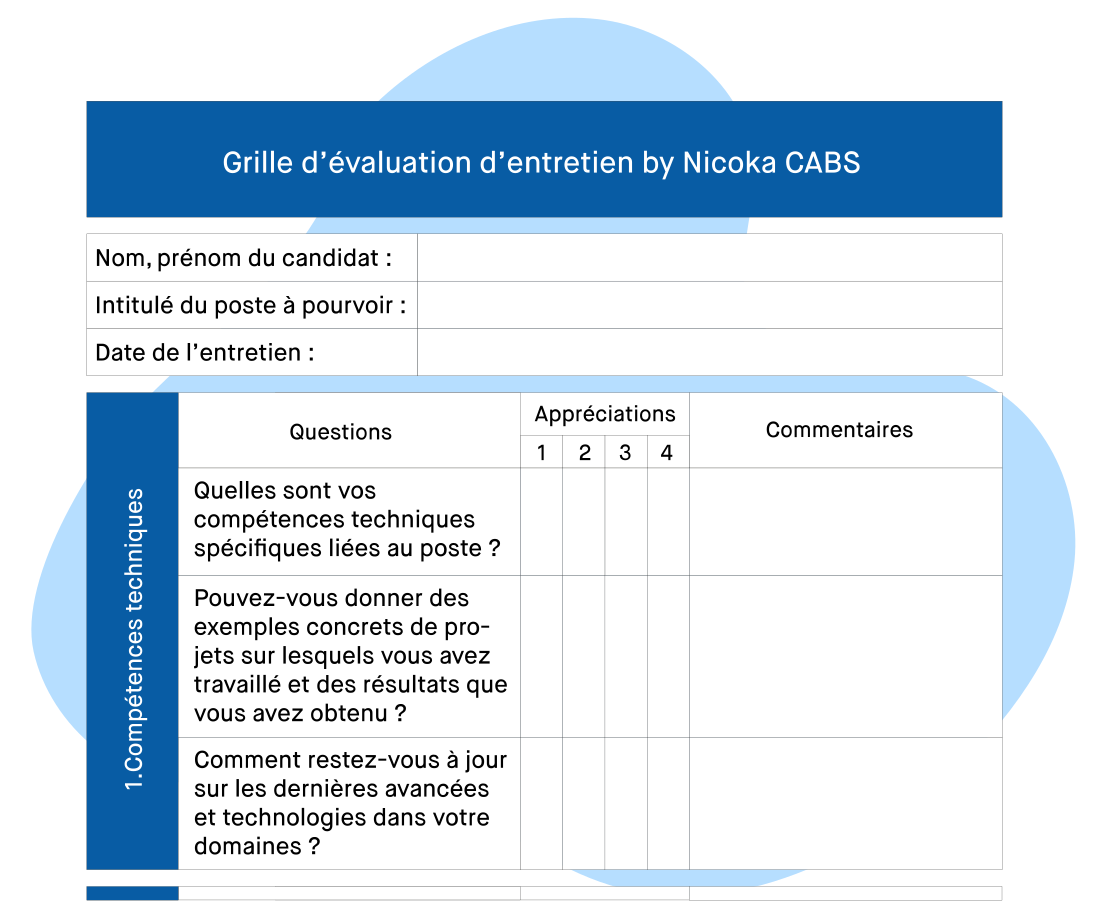
Discover our interview evaluation grid template
A well-structured job interview process is essential to identify the best-qualified candidates and those best suited to a role. To improve this crucial stage of recruitment, we suggest setting up an evaluation scorecard template.
This scorecard provides an objective, systematic framework to assess candidates' skills, experience and abilities, while taking into account your company's values and specific needs.
With this approach, we aim to make decision-making easier, guarantee a fair and even-handed assessment of every application, and so build a talented, diverse team that contributes to your organisation's success.
Verify question compliance with candidate privacy
Maintain information confidentiality
Ensure personal information of candidates is protected and only disclosed to individuals involved in the recruitment process.
Focus on skills and qualifications
Ask questions that focus on skills, qualifications, and experience relevant to the position.
Comply with data protection laws
Ensure compliance with personal data protection laws and obtain the candidate''s consent to collect and process their personal data.
Avoid discriminatory questions
Do not ask questions that could discriminate against candidates based on their age, gender, religion, ethnic background, marital status, etc.